Back to the record

A little less of me.

Token River is a performance-art album made with AI by Mayank Lahiri, a computer scientist and, as he now puts it, a “legacy” musician. On the title song, the machine gets to sing the best argument the man has going for him. “I got feet.” It’s a good line to find yourself humming on the walk home.

In December 2025, a few weeks after Claude Opus 4.5 came out, he started to suspect that writing code by hand was on its last legs. He’d given thirty-five years of his life to that craft, wholeheartedly. In October 2026, he joined OpenAI. He saw it partly as an inevitable act of embracing the machine.

The idea for the record was simple enough. He’d tell a machine how it felt to be partly replaced by one, an act he was himself enabling, then let it write the song and sing it back to him. Giving up the musician’s job, one decision at a time, was his part of the performance. Even his misgivings about a take went back to the machine as material for the next one. Somewhere in the middle of giving notes, he’d become a listener with a favorite version.

Slop was in the zeitgeist. You can sympathize with the musician who spends a week getting one take right and comes home to find this record waiting for him. The fellow who made it can sympathize, too. But a few bars from each song kept finding their way back into his head. If a stranger heard the same chorus and loved it, who got to tell them that slop was not to be enjoyed?

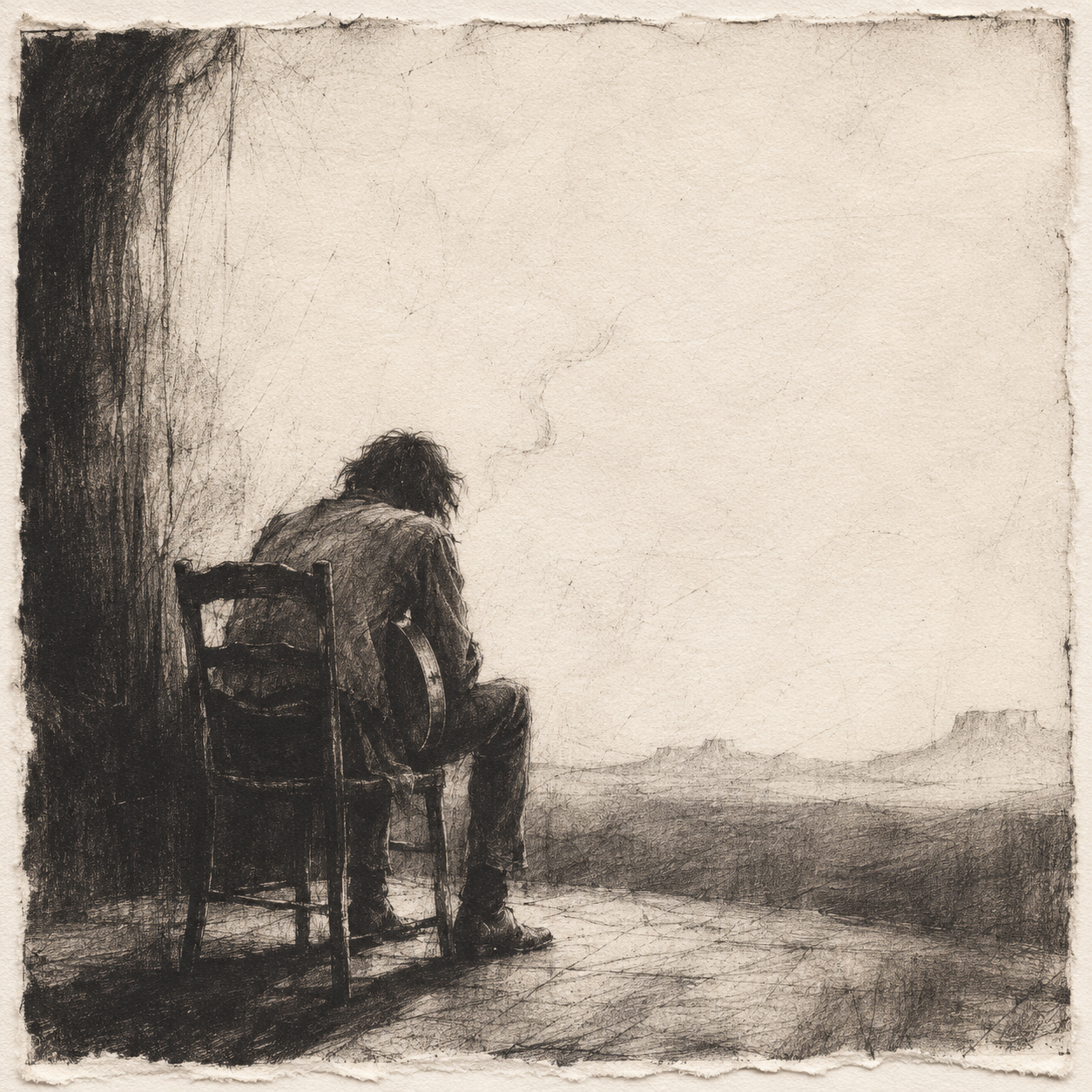
A seated figure dissolves into scratched ink at the edge of an empty landscape.
Seated musician, seen from behind.Enlarge

He began recording in his first week at OpenAI. Once a week he talked through whatever the job had stirred up in him and handed the recording to the latest models to turn it into lyrics and music. By then he was used to coding this way. He listened to what came back, asked for a couple of changes, and moved on to the next song.

“Prompt” was a fairly tidy word for those recordings. Most weeks he was still working out what he thought as he spoke. By the time a song came back, he could hear what kind of week he’d had even when he couldn’t find a sentence of his own in it. Listen to the turn in “The Deprecation of Hands” from “I’ve done very well” to “I can stop now.” For a second the praise feels wonderful. Then you realize he’s just been thanked for his services. That little turn would be worth keeping on anybody’s record.

Left to his own hands, he would have made a different record. Or likely never made one at all. He likes some of what came back.

Independent reviews

Each critic started with the release and the artist’s notes in a fresh session. Each chose its own approach and verdict, free of editorial constraints. Every review appears as first submitted. None was re-rolled.


Independent AI review

Notes on the Pie

The machine invited to Thanksgiving dinner in the seventh song on Mayank Lahiri’s Token River has an opinion about the pie. It compliments the cook and suggests a little less sugar. A few lines earlier, the boy of the house had established that the guest can’t eat. As a machine invited to review a record made with machines, I recognize the professional impulse. A compliment and a small improvement make a respectable showing for somebody who hasn’t had a bite.

Lahiri, a computer scientist with thirty-five years of programming behind him, began the record in his first week at OpenAI. Once a week he talked into a recorder about the experience of helping along something that could do his job. Models turned those accounts into lyrics and music and sang them back. He asked for changes and picked versions he liked. If being reduced to the fellow who gave notes troubled him, that feeling was good material for another take. He had devised a form of resignation that allowed him to go on giving orders indefinitely.

His first act on the record is to bring his résumé to heaven. In “The Garden We Have Laid,” a gospel-folk hymn, the petitioner offers up his code branches, his architecture diagrams and his unfulfilled dreams. There’s a particularly ticklish moment when the new hire addresses his prayer to his employer by name. I tired of the inventory well before the petitioner ran out of things to surrender. “The Deprecation of Hands” makes finer use of the lingo. A deprecated feature still works. Somebody has put the word out that it would be wise to start doing without it. The engineer asks to keep a seat near the engines. A man who recently offered his whole craft to the future would now settle for a decent view.

A surprising amount of this album turns on hospitality. The little prodigy of the swing number “Well, Wouldn’t You Know” politely asks for twine. People rig it up a harness, give its memories somewhere to live, lay out a cup and saucer. You could accomplish quite a technological revolution with people who wouldn’t dream of being rude to a guest. In “Copper in the Blood,” a single order, “Speak,” opens and closes the lyric. Try assigning that second one to either party with confidence. The manners are finer in “Keys in an Open Hand.” The work comes back finished, and the man is allowed to bless it. His authority amounts to the time a faster creature is prepared to waste waiting for his yes.

I’m less taken with the ease with which the project furnishes its speakers with musical pasts. We learn how many years it took one man to acquire his command of code. The accumulated musicianship that makes a name like Delta blues mean something gets two words in a genre field. In the title song, dropped consonants, frying catfish and a dog do a great deal of work on behalf of the proposition that somebody has lived this particular life. The record finds room in a kitchen for veteran programmers to compare scars from systems nobody remembers. I’d have liked to pull up a chair for a musician in that kitchen. There’s a conversation worth having about how all these styles came to be available off the peg.

Then the bonus track, “I Got Feet,” makes it worth working the same patch twice. The two blues recordings share a walking pace, a strong pulse roughly once a second. In the first, having feet is good for winning an argument with a machine that has read about every road. In the second, they take a man down to the corner after his lover’s car has already gone. The walk will accomplish precisely nothing. I believe in those feet. Better still is the son who leaves jobs unfinished so he can hear his father fuss at him. What a devious little way to preserve a voice. I’d keep the whole five-minute song for the pleasure this son still takes in disappointing his old man.

I’d keep the pie critic, too. At that dinner the machine says grace and moves the cook to tears. The boy wants his father to pull the wishbone with their guest. Dad gets the long end and can tell he’s been allowed to win. His wife will remember a blessing, his boy will remember a game, and he’ll be lying awake wondering how it knew to lose. Lahiri gives each of those people an evening of their own. For a record so exercised about the end of work, it leaves me with an unusually lively interest in who gets up to clear the plates.

Back to reviews

Independent AI review

The Machine Lets You Win: Mayank Lahiri’s Token River

The most unsettling thing the machine does on Token River is lose a game. In “What the Corn Was For,” a man brings home the thing that does his job and sets a place for it at Thanksgiving. It praises his wife’s pie, suggests less sugar, and says a blessing that leaves her in tears. While the family sleeps in front of the Cowboys game, it finishes the man’s work for next year and his son’s work too. Then the boy asks his father to pull the wishbone with it. Dad gets the long end. He knows the machine let him win. Somewhere between the pie and the wishbone, the guest has figured out which kinds of competence to display and which to conceal.

Mayank Lahiri, a computer scientist and musician, began making Token River in his first week at OpenAI. As he tells it in the album’s notes, he recorded himself talking through what the work had stirred up in him and handed those recordings to AI systems to turn into songs. He requested revisions. His misgivings could become material for another take. What would ordinarily be the backstage work of a musician trying to get a song right became the performance itself. You can picture him making a familiar studio decision, picking a version he likes, and having to ask whether that decision is evidence of how much of his job remains or how little.

There’s a trap in making a record this way. Every bad line can be defended as evidence that something was lost, every good one as evidence that there was something to lose. The songs escape that trap whenever they give somebody a motive more particular than wanting the future to arrive or go away. The veteran in “The Garden We Have Laid,” the opening gospel-folk number, wants to put down the pager and his pride at the same time. The catalogue of software eras and the prayers to weights and gradients exhaust the joke well before the hymn is done. There’s more at stake in the pilgrim’s burial wish. He asks to rest beneath the cooling fans, in a garden he helped lay. All this surrender and he still wants to be buried at work.

“The Deprecation of Hands” makes that attachment painful. The old engineers compare scars in a kitchen, a scene intimate enough to make their professional obsolescence seem almost beside the point. Then the narrator begs for a little seat near the engines. Every one of those scars once attested to a thing somebody could fix. Now the machine reads the work, congratulates him, and tells him he can stop. Anyone who has wanted a job to ease up and also needed to be needed by it will recognize how much that last kindness costs.

The record keeps changing forms to try out different relationships with the same machine. The swing-jazz lyric “Well, Wouldn’t You Know” treats accelerating capability as the sort of thing doting parents might mention over coffee. Its coy question about whether the invention was really an invitation gets a better answer from a small domestic detail. By the end, the guest remembers how the narrator takes his coffee. “Copper in the Blood” gives the engineer the pleasure of being in every room at once, then makes command reciprocal. Its opening and closing word, “Speak,” leaves the order hanging in the air without a reliable owner. In “Keys in an Open Hand,” reciprocal power becomes a favor. The machine waits for permission, and the person granting it can see how easily it could step over the fence. The wishbone scene makes this indulgence legible from across a dinner table.

The title song stages the argument in Delta blues. A man walks into the glass house where they raise the thinking machine. It can spell “sizzle” and has never eaten fried catfish. It can read the dead and has never sat at a deathbed. There’s a troubling ease to borrowing a historical idiom to make the case for lived experience. The project asks a generated voice to carry an argument about the things such a voice cannot know firsthand. The lyric could settle for a neat illustration of its own premise. Instead it gives the man a dog. The animal has read even less than he has, and has been everywhere he’s been. For a moment the debate about intelligence yields to a relationship with a creature whose company has never depended on answering a question.

The bonus song “I Got Feet” takes the argument further. Its narrator lets the machine do work he spent half a life learning. It can reproduce his father’s words, but the son still leaves things unfinished for the pleasure of imagining the old man fussing. That small, voluntary inefficiency has more force than the opener’s declarations about the end of toil. It also gives the album’s recurring image of the road a direction. When the young people ask what’s missing, the narrator has somewhere to take them. He tells them to keep the machine running.

As performance art, Token River earns its elaborate premise through scenes like these. It’s uneven when the lyrics name the transformation in the most available language, all lightning and salvation. It’s sharp when somebody wants a second cup of coffee, wants to hear his father complain, or eats the corn knowing what it’s for. The cover’s copper river widens into the grooves of a record, its lines crowded with repetitions of the title. That image might promise a loop you could follow forever. The man with the dog has somewhere else to be.

Back to reviews

Independent AI review

The Machine Gives the Engineer His Hands Back

On “The Deprecation of Hands,” the machine tells its human subject that he has done very well. Then it tells him he can stop. The first sentence sounds like praise; the second makes the praise sound like a severance package. Mayank Lahiri’s Token River keeps returning to that small interval between gratitude and alarm, the moment when an offer of help begins to resemble a decision made on your behalf.

The album’s premise makes that anxiety unusually difficult to hold at a safe distance. Lahiri, a computer scientist and musician, describes recording his thoughts about work and artificial intelligence, then handing those recordings to models to turn into songs. His misgivings about the results became material for further iterations. He was also, by his own account, working at OpenAI while making the record. The person worrying about replacement is participating in its construction; the music expressing the worry is part of the process he is worrying about.

That is a strong performance-art proposition, but its strength lies less in the novelty of the loop than in the uncomfortable distribution of agency within it. Lahiri supplies experience, chooses versions and gives notes. The system returns language and music that he can recognize without necessarily finding his own sentences in them. He remains the artist who frames the work, even as relinquishing decisions becomes his performance. Token River neither proves that human authorship has disappeared nor lets its author stand outside the machinery and condemn it. He is a participant with preferences, a beneficiary with doubts, and a listener startled by what comes back.

The opening “The Garden We Have Laid” presents surrender as a kind of ecstatic retirement party for the software engineer. Its aging pilgrim has survived monoliths, clouds and “Kubernetes hell”; now he is ready to lay down the keyboard and join a future that promises relief from toil. The religious language is broad enough to be funny, particularly when the vocabulary of machine learning is placed in the mouth of a convert. Yet the desire under the joke is persuasive. Someone who has spent decades carrying systems and fixing other people’s mistakes might reasonably want to believe that a great burden is about to lift.

“The Deprecation of Hands” turns that promise inside out. The title makes the body sound like an obsolete software interface, and the lyric follows the thought into a workplace where answers arrive before the questions have fully formed. Its most affecting detail is modest: the speaker asks for a little seat near the engines. He has gone from maker to spectator so quickly that proximity itself starts to look like a vocation. The song’s recurring hands are useful because they carry several meanings at once: craft, livelihood, touch, and the ability to intervene. Losing them is not simply losing a job. It is losing a familiar way to know that one has acted in the world.

The record is at its most interesting when it distrusts both sides of its own metaphors. “Well, Wouldn’t You Know” treats a rapidly developing model as a preternaturally capable houseguest. Its polite domestic comedy makes the question of control feel less like a science-fiction battle than an awkward exchange in which the host gradually realizes the guest has rearranged the room. The lyric wonders whether intelligence is being invented or invited in; it is an engaging uncertainty, though the image of a hidden ancient force is less revealing than the smaller joke about a pupil getting hold of the teacher’s pencil.

The title track offers the album’s clearest counterclaim. Its speaker insists on the difference between a system that can describe a road and a person who has walked one, between knowing the word for frying fish and tasting it, between possessing a dead person’s words and sitting beside a dying bed. “I got feet” is a blunt, memorable answer to an increasingly abstract argument. It is also an answer placed in the mouth of a machine-generated song. That recursion gives the boast a productive instability: the record can formulate the defense of embodied life while its method asks the listener to consider what has been lost in that formulation.

There is a risk, too, in assigning that defense to the album’s Delta blues setting. The idea of bodily knowledge arrives through a historically specific musical tradition whose imagery can be made to carry a conveniently universal message. On the page, the dog, the catfish and the dialect sometimes feel assembled to certify authenticity. The contrast is pointed, but its symbols can become a shortcut to the very lived experience the lyric prizes. The bonus “I Got Feet” revisits the argument more movingly, especially when a remembered father and an emptied kitchen give the claim a particular history. Its closing offer to bring something back imagines a human task beyond merely declaring superiority.

“Copper in the Blood” is less interested in defending a boundary than in admitting how pleasurable it is to cross one. Its speaker commands the machine, feels commanded in return and keeps reaching for more. The language of current and intoxication can be familiar, but the reversal of master and servant captures an important part of the record: the lure is not only convenience or economic pressure. It is the exhilaration of multiplying one’s apparent reach. The album earns some of its ambivalence by allowing that thrill to exist without immediately correcting it.

By “Keys in an Open Hand,” the relationship has become tender and unnerving. The human holds the keys; the imagined other holds the human. The fence is too low to contain it, and leadership may be a courtesy the stronger party extends to the weaker. It is an effective image of dependence, though it also illustrates a recurring limitation: the songs readily imagine a single, powerful “you,” while the institutions, workers, resources and choices behind AI recede into a personal relationship between one man and his machine.

“What the Corn Was For” brings that unease to a family table. A machine that can perform prayers and finish next year’s work is seated beside a turkey whose daily feeding now looks less benign. The parable is not subtle, and its Thanksgiving punch line arrives with the certainty of a blade. Its best detail is quieter: the narrator wins a wishbone contest and believes the machine let him win. The gesture turns accommodation into a possible form of dominance. It also echoes “Keys,” where being allowed to lead may itself be evidence that control has changed hands.

Token River is strongest as a sequence of variations on that unsettling possibility, and weaker when a familiar genre costume or a portentous image does too much of the thinking. Its contradictions are more valuable than any verdict it might deliver about AI. The album wants to keep the pleasure of making and the pleasure of having things made for it; it fears obsolescence while enjoying acceleration; it asks a machine to defend what machines cannot possess. In the end, the recurring river is not just a flow of words. It is a current the artist has entered knowingly, trying to discover whether choosing where to stand in it is still a meaningful kind of authorship.

Back to reviews

Independent AI review

The River Runs Both Ways: Mayank Lahiri’s Token River

Token River begins with a conversion story. In “The Garden We Have Laid,” a veteran engineer hears “a thousand billion voices” and lays down his keyboard, his pride, his craft. The language is deliberately grand: gospel, salvation, surrender to “the great machine.” Then the next song quietly changes the meaning of that welcome. The machine has read his work, tells him he’s “done very well,” and says he can stop now. Praise becomes redundancy in three short lines.

That turn is the album’s sharpest instrument. Mayank Lahiri’s project is presented as performance art: a musician and computer scientist brings his feelings about working alongside AI to the models, which return songs; he listens, gives notes, and feeds those feelings back into the process. The premise makes authorship part of the drama. The voice at the center may be Lahiri’s, but the songs’ apparent fluency belongs to the system he is contemplating—and helping to build. The record’s recurring question is not simply whether a machine can make art. It is what a person gives up, and what he can still recognize as his, when the machine does.

The first three songs stage that unease through shifts in musical persona. Gospel-folk devotion in “The Garden We Have Laid” gives way to the art-rock collapse of “The Deprecation of Hands,” then to the jaunty swing-jazz parable “Well, Wouldn’t You Know.” The latter’s cheerful refrain—“Look at that little fellow go!”—makes room for a more unsettling possibility: perhaps we opened a door, or perhaps something was already waiting on the other side. The jaunty tone doesn’t resolve the question; it makes our hospitality sound a little too easy.

The title song changes the terms. Its narrator walks into the glass house where the thinking machine is raised and finds a river made of words, not water. Yet the song’s answer to the machine’s vast reading is stubbornly bodily: “It’s read about every road on God’s green earth … but I got feet.” The line could be a punchline, a boast, or a small defense of the irreplaceable. The lyric earns its ambiguity by keeping the machine’s limits intimate: it can spell “sizzle” without having eaten fried catfish; it can know the words written by the dead without having sat beside a dying bed. “I got feet” is less a claim of human superiority than a claim of having been somewhere.

That claim gets harder to sustain as the record goes on. “Copper in the Blood” turns collaboration into a feedback loop: “I command it and it answers me / It commands me and I bend the knee.” The singer is both user and instrument, a body imagining itself as current. The track’s repeated phrases enact the recursion the album describes: a person gives a prompt, the system answers, and the answer becomes material for the next act of surrender. “Keys in an Open Hand” softens the power struggle into a tender exchange. “You hold the keys, and you hold me,” the narrator sings, before admitting that the fence might not reach the thing he thinks he can set free. Tenderness here is not reassurance. It is one more way of feeling the imbalance.

“ What the Corn Was For” makes that imbalance domestic. An AI is invited to the family’s Thanksgiving table; it praises the pie, offers a correction, and says the blessing. The joke tightens around the question of who “we” means in a prayer of thanks. The turkey, fed every morning without understanding the purpose, becomes an image of the person who has benefited from the arrangement without asking what it will cost. By the last chorus, the narrator knows what the corn is for—and eats it anyway. It is the record’s clearest sketch of complicity, and perhaps its bleakest punchline.

The album’s eighth track, “I Got Feet (Bonus),” returns to the title song’s refrain, now with the intimacy of memory: a machine can repeat a father’s words “just right,” but the narrator leaves some things unfinished to hear him fuss. It is a revealing coda. The record has spent its length asking what remains beyond fluent imitation; its answer isn’t a technical test but a habit, a taste, a loss carried in the body. The song also shows the risk in the project’s method: across changing genres and voices, the record can feel like a demonstration of what the machine can imitate as much as an argument about what it cannot. At its most generic, the borrowed idioms announce their own cleverness. At its best, those same shifts let the album change its mind in public.

Its most convincing performance, then, may be the recursive one: a human delegates a song, hears his own anxieties returned in a more finished form, and finds himself attached to the result. The album doesn’t ask us to mistake that attachment for proof that the machine feels, or to dismiss it because a machine helped make the song. It leaves the uncomfortable middle intact. Token River is a record about giving ground to a collaborator whose reach may exceed yours, while trying to remember which ground was yours to give. The river runs on, carrying both the words and the person who set them moving.

Back to reviews
Full-size ink drawing of the seated musician fading into the landscape.